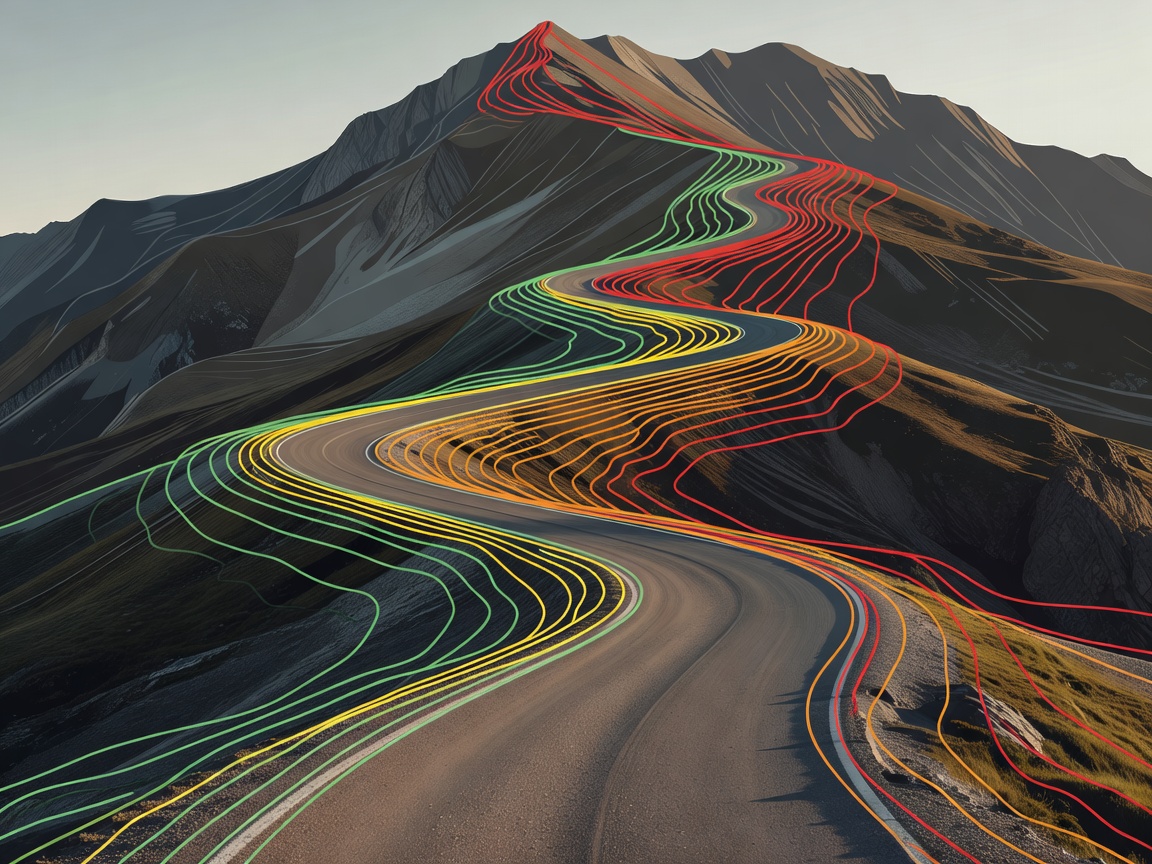
What a category describes
Race organisers classify climbs for the mountains competition. The system normally uses a hierarchy in which the hardest ascents receive the highest designation and the most points. The Tour de France uses categories including hors catégorie and categories one through four. The Giro d'Italia and Vuelta a España use their own classifications and points schedules.
There is no universal formula that turns length and gradient into a category across every race. Organisers consider difficulty, and the official route materials state the classification and points for each summit. That is why comparing category labels across races should be done carefully: the same label is not a promise of identical physical difficulty.
Length, gradient and rhythm
A long climb at a steady gradient asks for sustained pacing. A shorter ascent with sharp changes may demand repeated accelerations. Average gradient is useful but incomplete because it smooths out steep ramps and flatter sections. The road surface, hairpins, altitude and weather can change how a climb rides, too.
For spectators, the profile tells a better story than a single number. Look for where the steepest section appears. A steep opening can break a group early; a steep finish can reward a late attack. A flatter section near the top may allow a rider who has been dropped to return, especially if they find another wheel.
Position within the stage
The same climb has a different tactical meaning at the beginning and end of a stage. An early classified ascent is often a place for breakaway riders to collect points. A final climb is where GC teams remove domestiques and leaders measure one another directly. A climb followed by a long descent changes the calculation again: gaining seconds uphill is useful only if the gap can be preserved.
Multiple climbs create attrition. The first may not produce the winner, but it can reduce the group and drain the riders who would otherwise protect a leader. By the last ascent, the race is shaped by what has already been spent.
Mountain points versus GC attacks
The mountains classification encourages riders to cross selected summits first. A breakaway specialist may target points all day, pacing the earlier climb hard and preserving enough to reach the next. A GC contender may ignore those points because their priority is time against rivals at the finish.
This produces different racing lines on the same hill. One rider attacks for the summit banner; another waits for a section where a rival is isolated. Neither approach is more “real” climbing. They answer different scoreboards.
Reading a mountain stage
Start with the final two climbs, then work backwards. Is there a descent or valley between them? Are there enough difficult roads beforehand to exhaust the teams? Is the finish uphill? Those questions reveal whether the stage is likely to favour a long-range move, a controlled final ascent or a breakaway.
Categories offer the map legend. The terrain, sequence and riders’ objectives write the actual race.